Microcement stairs in a home with children and a dog: durability, edges, safety
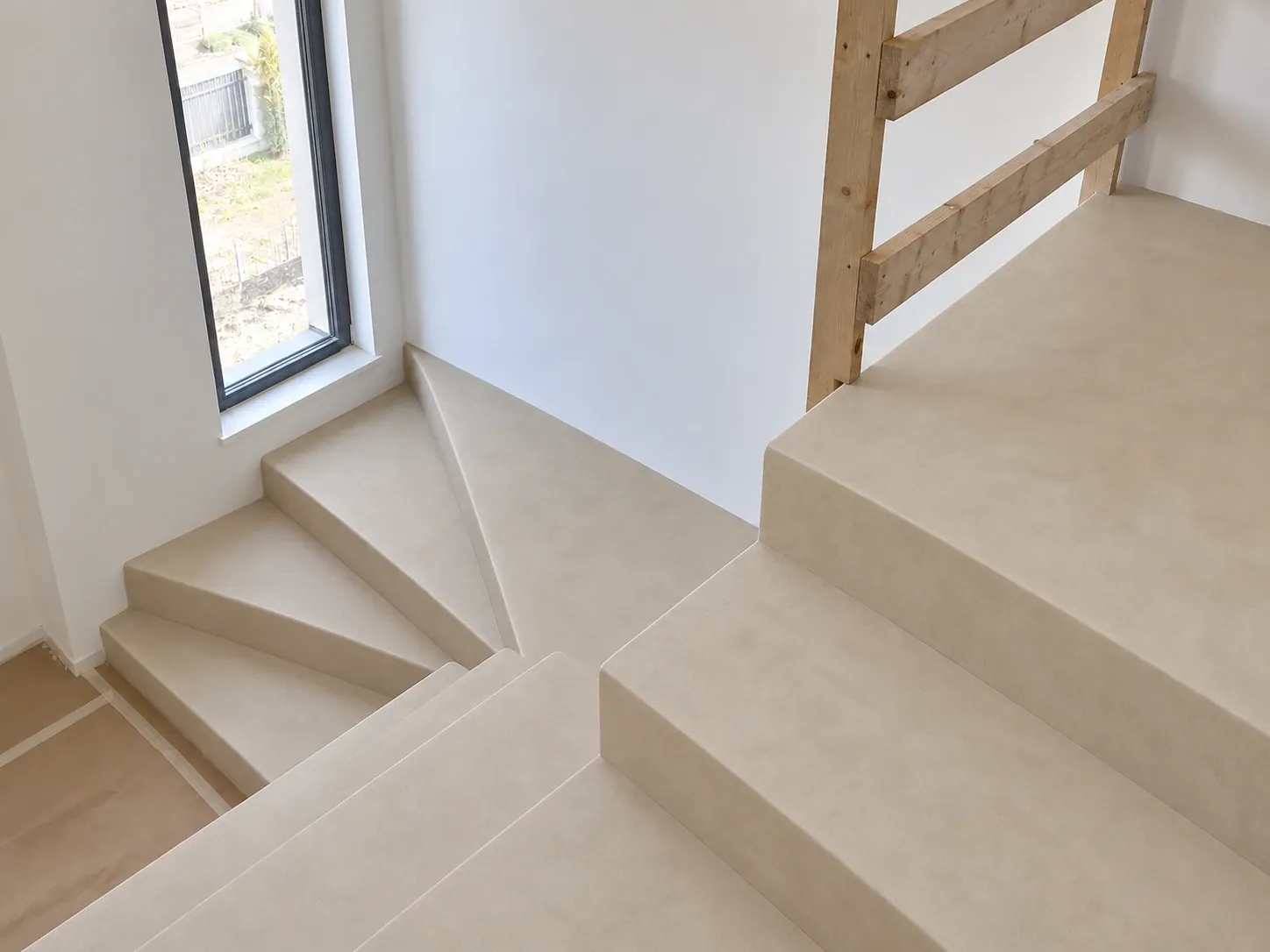
Stairs are visible from the whole house and are also one of its most heavily used elements. Every step takes thousands of footfalls, and its edge takes knocks from the vacuum cleaner, toys and suitcases. Microcement gives stairs the look of a single sculptural volume in the colour of the floor. In this article we answer the questions parents ask before deciding.
Published · 4 min read
Microcement, timber or stone
Timber is warm and quiet underfoot, but dog claws scratch it and it needs sanding. Stone is very hard but cold, heavy and divided into pieces with joints. Microcement sits in between: it is hard but not cold like stone, and above all it forms one continuous surface with the floor downstairs and upstairs.
For many families continuity is what decides it. The stairs are no longer a separate "piece of furniture" in another material but an extension of the floor. The interior looks calmer and cleaning is easier, because there are no gaps where dust and hair collect.
Step edges: where durability is decided
The edge of a step is where everything lands: the vacuum, a balance bike, a wheeled suitcase. In microcement we build edges with extra reinforcement and form the corner very carefully. A slightly rounded edge resists chipping better and is kinder to bare feet.
Even so, microcement, like any surface, can chip under a hard blow from a metal object. The good news is that small damage is repaired locally, without replacing the whole step.
Children, socks and dog claws
The main question from parents is about slipperiness. On stairs we use a sealer with more grip than on walls and choose the finish according to whether the household walks barefoot, in socks or in slippers. With small children we can also add a subtle texture to the treads.
Dog claws mostly scratch soft and glossy surfaces. A matt sealer on microcement hides fine marks better than high gloss. Regular claw trimming also helps any floor.
Timber stairs: when yes, when no
Timber moves with humidity and temperature. If timber stairs are rigid, do not creak and do not flex, they can be prepared for microcement: we stiffen them with extra layers, reinforce them with mesh and only then apply the coating. If the treads creak or visibly move, the structure must be repaired first. Without that, cracks will appear along the board joints.
What to plan before work starts
Some decisions are best made early, because changing them after microcement is applied is awkward.
- Handrail: how and where it is fixed, ideally with holes prepared before our work.
- Step lighting in the wall: boxes and cables must be in place beforehand.
- The junction with the wall: whether the stairs get a microcement skirting or the wall stays painted.
- Order of work: when the stairs will be out of use and how to reach the upper floor then.
How the work runs and how to live with it
First we assess the structure and repair defects. Then we prime, reinforce the edges, apply two layers of microcement and the sealer. The whole process usually takes a few working days, and the stairs cannot be used for part of that time. If the house has only one staircase, we plan to keep that time to a minimum. Before handover we tell you when you can walk on them in socks, when in shoes and when furniture can be carried up.
Stair colour and the floors downstairs and upstairs
The calmest effect comes from the same colour on the floor and the stairs. The staircase then grows out of the floor and the house feels larger. You can also deliberately darken the stairs by a tone to emphasise their form, or pair them with a timber handrail and warm light in the wall.
Remember that light shades reflect the light from a window above the stairs nicely but show shoe marks sooner. Darker shades hide daily traffic well but show dust and pet hair more clearly. The colour is best chosen on a sample laid on one step and viewed at different times of day.
Everyday care of stairs
Stairs are cleaned just like a microcement floor: a vacuum with a soft head and a damp mop with a mild cleaner. Do not use shine products or waxes, because they change the grip of the surface. Do not stick anti-slip tapes with aggressive adhesive to the treads, and if you need extra grip, tell us and we will choose the right finish. After years of heavy use the sealer on the treads can be refreshed without touching the coating itself.